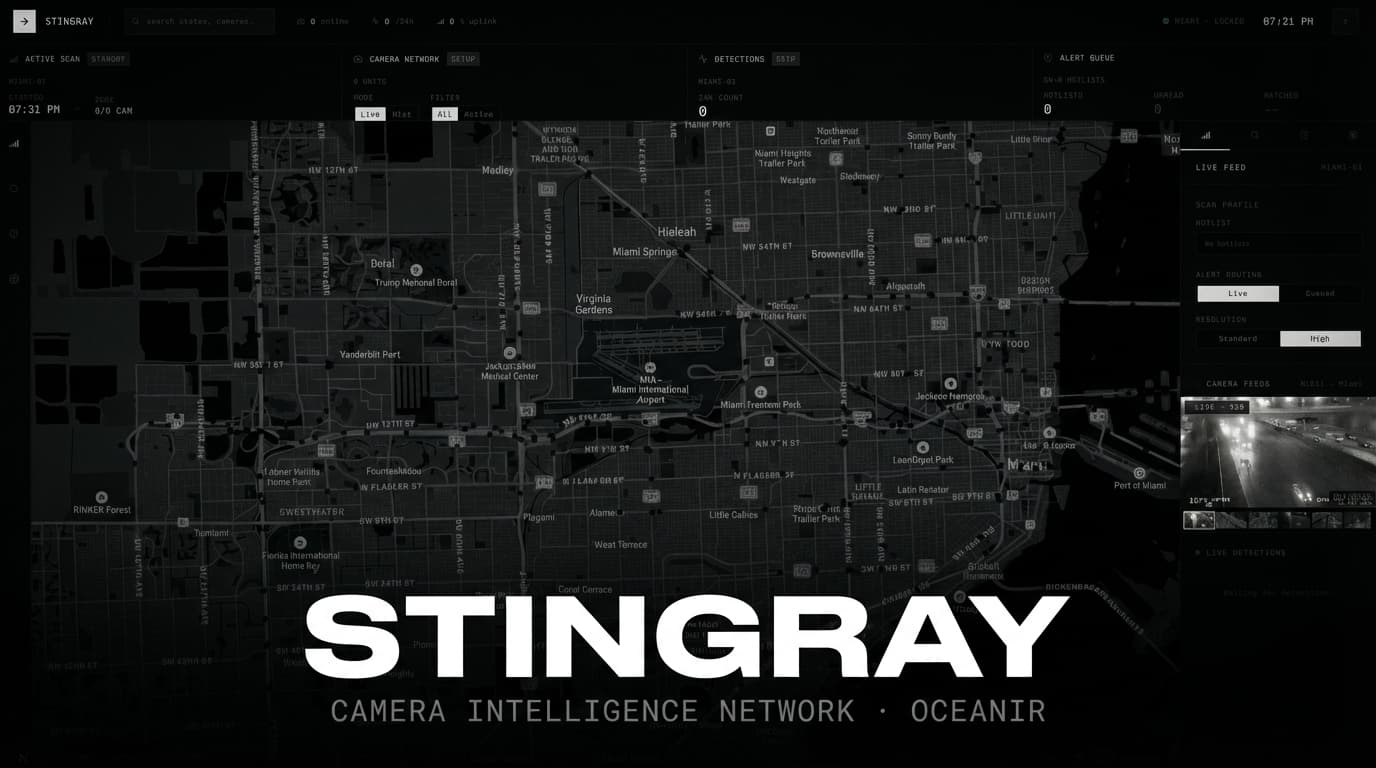
Today we're introducing Stingray — Oceanir's new module for real-time camera network intelligence. Where Orca tells you where something is from a single image, Stingray tells you what's happening across a network of cameras, continuously.
Stingray is built for operators — investigators, security teams, and field intelligence units — who need to monitor activity across multiple locations at once. It connects to camera feeds, runs automated license plate recognition, and surfaces detections in real time with zero manual review required.
The interface is designed around speed and signal. You see what matters. Everything else stays out of the way.
"A single image tells you where. A network tells you when, who, and how often. That's the difference between a lead and a pattern."
— Oceanir Team, 2026
What Stingray does
Stingray runs as a persistent scanning layer on top of your camera network. Each unit connects to live feeds, applies automated detection, and routes alerts based on rules you configure. It's not a passive archive — it's an active scan.
Connect and manage multiple camera feeds from a single interface. Each unit is assigned a zone and monitored independently.
Automated license plate recognition runs on every frame. Plates are matched against hotlists in real time — detections appear in the alert queue within seconds.
Alerts route to live queues or deferred review depending on priority. Hotlist matches are surfaced immediately. Everything else is batched.
Every detection is logged with timestamp, coordinates, and image evidence. 24-hour counts give you the pattern, not just the event.
Built for field operators
The Stingray interface is designed around the reality of field work. Operators need to make decisions fast, often in low-light conditions with fragmented data. The UI reflects that: high contrast, no noise, and everything in one view.
Active scan status, camera uplink health, detection counts, and live feed thumbnails are all visible at a glance. There are no dashboards to navigate, no drill-downs required for routine monitoring.
- Scan profiles — configure detection sensitivity and filter rules per zone. High-traffic areas run differently from quiet perimeters.
- Hotlist management — maintain plates of interest across operations. Matches are immediate; misses are silent.
- Resolution modes — standard and high-resolution capture. High resolution is used for active incidents where plate clarity matters.
- Lock mode — lock the interface to a specific zone for extended monitoring sessions without accidental navigation.
Availability
Stingray is in early access. We're working with a small group of operators to validate performance across different camera hardware and network configurations before a wider release.
If you're running a camera network and want to be part of the early access program, reach out through the link below. Priority is given to teams with existing deployments who can give us real-world signal.
Early Access
Stingray early access is open to qualified operators. Contact us to discuss your use case and network setup.
Request access →